Our History
A five-century journey of faith, resilience, and cultural preservation
The Sacred Timeline
The story of Shri Damodar Temple is one of devotion surviving persecution. From its original home in Margao to its sanctuary in Zambaulim, the temple has endured for over 500 years.
c. 1500 — The Original Temple
The grand temple of Damodar stood at Damodar Sal in Margao, so large that Muhammadan forces once occupied it as a military post.
1565 — Portuguese Destruction
Captain Diogo Rodrigues destroyed at least ten temples in Margao under orders from the Archbishop; the Church of the Holy Spirit was consecrated on the Damodar Sal site.
1565–1567 — Flight of Gods
Six sacred deities — Ramnath, Damodar, Lakshmi-Narayana, Chamundeshwari, Mahakali, and Mahesha — were secretly relocated to Zambaulim via the Keni House in Comba. The Desais of Rivona donated land and established a hereditary Vatan for the temple’s upkeep, a commitment that continues to this day.
1892–1910 — Renovation & Growth
A distinctive copper-plated shikhara was added between 1892 and 1908, giving the temple its characteristic North Indian-style tower. By 1910, the temple was expanded to its current form and a shrine to Lord Venkatesh was installed with a sacred Saligrama.
1951–1972 — Complete Renewal
A comprehensive renovation transformed nearly every part of the temple — walls, pillars, ceilings, and decorative elements — while preserving its spiritual integrity.
Present — A Living Heritage
Over 100,000 devotees gather each year for Shigmo Gulalotsav, and daily worship connects an unbroken chain of devotion stretching back five centuries.
The Flight of Gods
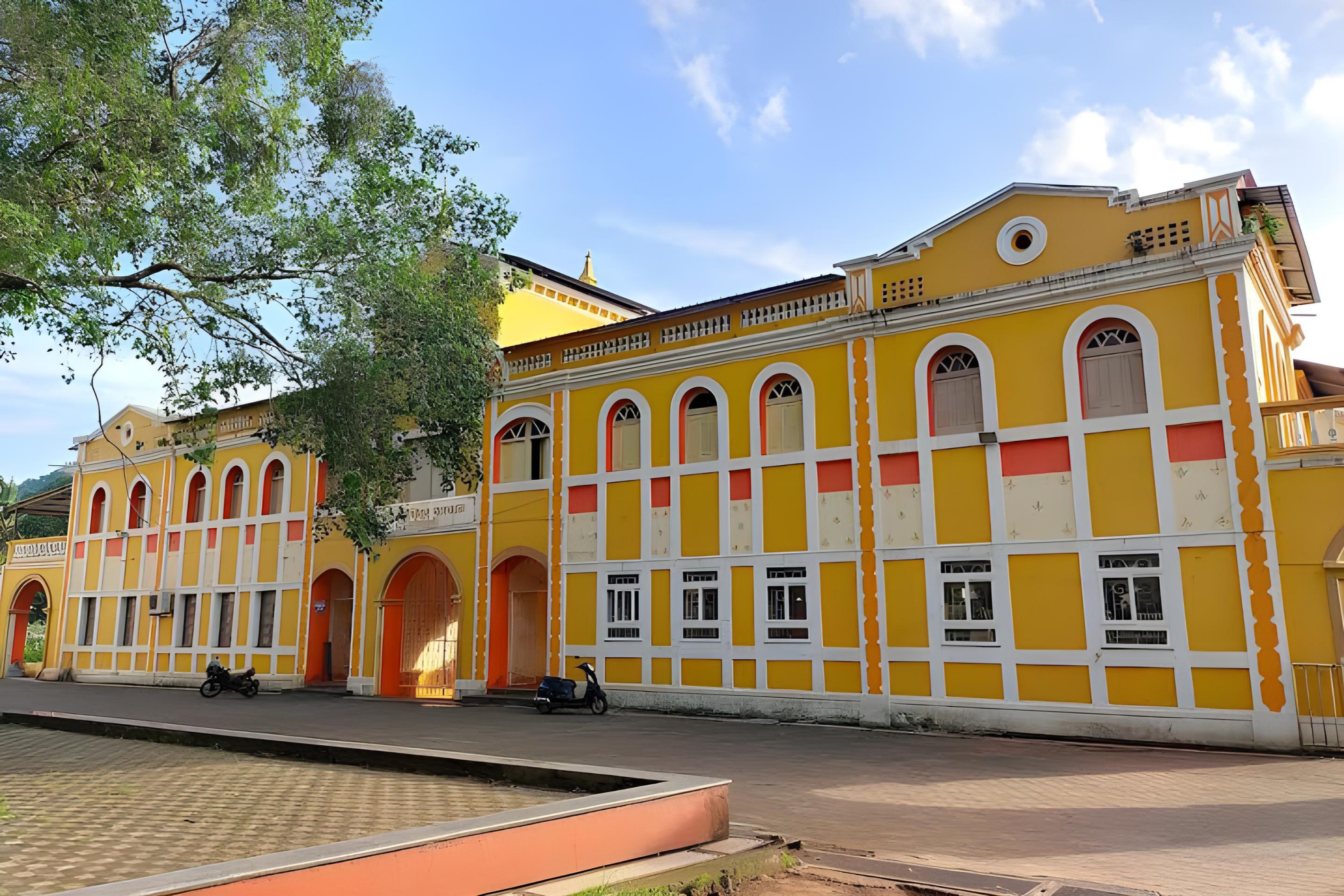
In 1565, under Archbishop Dom Gaspar de Leão Pereira, Portuguese forces launched a systematic campaign of temple destruction across Salcete and Bardez. Approximately 300 temples were demolished across Goa.
In Margao, Captain Diogo Rodrigues razed at least ten major temples, including the grand shrine at Damodar Sal. But the temple’s mahajans refused to accept this erasure. Under cover of darkness, they carried six sacred deities to the Keni house in Comba — a temporary refuge — before completing the perilous journey to Zambaulim, beyond direct Portuguese ecclesiastical control.
The Desais of Rivona donated land and established a Vatan (hereditary stipend) that endures nearly five centuries later, creating the material foundation on which the temple community rebuilt. Within two years, ancient rituals resumed on the banks of the Kushawati.
The resilience of faith preserved what force sought to destroy.
Heritage Connections
The Church Connection
The Church of the Holy Spirit in Margao was built in 1565 on the exact site of the original Damodar temple, then rebuilt in its magnificent Baroque form in 1675. Rather than a source of division, this shared ground is an emblem of Goa’s layered cultural identity, where Hindu and Catholic heritage coexist across centuries.
The Makaji Legend
An alternative local tradition holds that the temple honours Makaji Damodar, a village administrator’s son who was murdered alongside his bride by a rival suitor’s assassins. The grief-stricken community built a memorial that evolved into a place of worship — a folk origin that may predate the Margao relocation.
The Traditions Live On
Discover the sacred traditions preserved through these centuries.